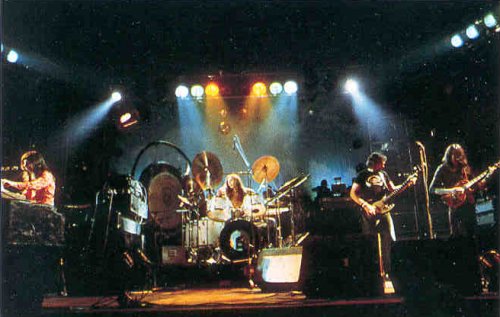
Rock music is a genre of popular music
that developed during and after the 1960s, particularly in the United
Kingdom and the United States. It has its roots in 1940s and 1950s rock and roll, itself heavily influenced by rhythm and blues and country music. Rock music also drew strongly on a number of other genres such as blues and folk, and incorporated influences from jazz, classical and other musical sources.
Musically, rock has centred around the electric guitar, usually as part of a rock group with bass guitar and drums. Typically, rock is song-based music with a 4/4 beat utilizing a verse-chorus form, but the genre has become extremely diverse and common musical characteristics are difficult to define. Like pop music,
lyrics often stress romantic love but also address a wide variety of
other themes that are frequently social or political in emphasis. The
dominance of rock by white, male musicians has been seen as one of the
key factors shaping the themes explored in rock music. Rock places a
higher degree of emphasis on musicianship, live performance, and an
ideology of authenticity than pop music.
By the late 1960s a number of distinct rock music sub-genres had emerged, including hybrids like blues rock, folk rock, country rock, and jazz-rock fusion, many of which contributed to the development of psychedelic rock influenced by the counter-cultural psychedelic scene. New genres that emerged from this scene included progressive rock, which extended the artistic elements; glam rock, which highlighted showmanship and visual style, and the diverse and enduring major sub-genre of heavy metal, which emphasized volume, power and speed. In the second half of the 1970s, punk rock
both intensified and reacted against some of these trends to produce a
raw, energetic form of music characterized by overt political and social
critiques. Punk was an influence into the 1980s on the subsequent
development of other sub-genres, including New Wave, post-punk and eventually the alternative rock movement. From the 1990s alternative rock began to dominate rock music and break through into the mainstream in the form of grunge, Britpop, and indie rock. Further fusion sub-genres have since emerged, including pop punk, rap rock, and rap metal, as well as conscious attempts to revisit rock's history, including the garage rock/post-punk and synthpop revivals at the beginning of the new millennium.
Rock music has also embodied and served as the vehicle for cultural
and social movements, leading to major sub-cultures including mods and rockers in the UK and the "hippie" counterculture that spread out from San Francisco in the US in the 1960s. Similarly, 1970s punk culture spawned the visually distinctive goth and emo subcultures. Inheriting the folk tradition of the protest song,
rock music has been associated with political activism as well as
changes in social attitudes to race, sex and drug use, and is often seen
as an expression of youth revolt against adult consumerism and conformity.
CHARACTERISTICS
The sound of rock is traditionally centered around the electric guitar, which emerged in its modern form in the 1950s with the popularization of rock and roll.
The sound of the electric guitar in rock music is typically supported by the electric bass guitar pioneered in jazz music in the same era,
and percussion produced from a drum kit that combines drums and cymbals.
This trio of instruments has often been complemented by the inclusion of others, particularly keyboards such as the piano, Hammond organ and synthesizers.
A group of musicians performing rock music is termed a rock band or rock group and typically consists of between two and five members. Classically, a rock band takes the form of a quartet whose members cover one or more roles, including vocalist, lead guitarist, rhythm guitarist, bass guitarist, drummer and occasionally that of keyboard player or other instrumentalist.
Rock music is traditionally built on a foundation of simple unsyncopated rhythms in a 4/4 meter, with a repetitive snare drum back beat on beats two and four.
Melodies are often derived from older musical modes, including the Dorian and Mixolydian, as well as major and minor modes. Harmonies range from the common triad to parallel fourths and fifths and dissonant harmonic progressions.
Rock songs from the mid-1960s onwards often used the verse-chorus structure derived from blues and folk music, but there has been considerable variation from this model.
Critics have stressed the eclecticism and stylistic diversity of rock.
Because of its complex history and tendency to borrow from other
musical and cultural forms, it has been argued that "it is impossible to
bind rock music to a rigidly delineated musical definition."
Unlike many earlier styles of popular music, rock lyrics have dealt
with a wide range of themes in addition to romantic love: including sex,
rebellion against the establishment, social concerns and life styles.
These themes were inherited from a variety of sources, including the Tin Pan Alley pop tradition, folk music and rhythm and blues.
The predominance of white, male and often middle class musicians in rock music has often been noted
and rock has been seen as an appropriation of black musical forms for a young, white and largely male audience.
As a result it has been seen as articulating the concerns of this group in both style and lyrics.
Since the term rock began to be used in preference to rock and roll
from the mid 1960s, it has often been contrasted with pop music, with
which it has shared many characteristics, but from which it is often
distanced by an emphasis on musicianship, live performance and a focus
on serious and progressive themes as part of an ideology of authenticity
that is frequently combined with an awareness of the genre's history
and development.
According to Simon Frith
"rock was something more than pop, something more than rock and roll.
Rock musicians combined an emphasis on skill and technique with the
romantic concept of art as artistic expression, original and sincere".
In the new millennium the term
rock has sometimes been used as a blanket term including forms such as pop music, reggae music, soul music, and even hip hop, with which it has been influenced but often contrasted through much of its history.
ROCK AND ROLL
The foundations of rock music are in rock and roll, which originated
in the United States during the late 1940s and early 1950s, and quickly
spread to much of the rest of the world. Its immediate origins lay in a
mixing together of various black musical genres of the time, including rhythm and blues and gospel music, with country and western.
In 1951, Cleveland, Ohio disc jockey Alan Freed
began playing rhythm and blues music for a multi-racial audience, and
is credited with first using the phrase "rock and roll" to describe the
music.
Debate surrounds which record should be considered the first rock and roll record. One contender is "Rocket 88" by Jackie Brenston and his Delta Cats (in fact, Ike Turner and his band The Kings of Rhythm), recorded by Sam Phillips for Sun Records in 1951.
Four years later, Bill Haley's "Rock Around the Clock" (1955) became the first rock and roll song to top
Billboard magazine's main sales and airplay charts, and opened the door worldwide for this new wave of popular culture.
It has been argued that "That's All Right (Mama)" (1954), Elvis Presley's first single for Sun Records in Memphis, was the first rock and roll record,
but, at the same time, Big Joe Turner's "Shake, Rattle & Roll", later covered by Haley, was already at the top of the Billboard R&B charts. Other artists with early rock and roll hits included Chuck Berry, Bo Diddley, Fats Domino, Little Richard, Jerry Lee Lewis, and Gene Vincent.
Soon rock and roll was the major force in American record sales and crooners, such as Eddie Fisher, Perry Como, and Patti Page, who had dominated the previous decade of popular music, found their access to the pop charts significantly curtailed.
Rock and roll has been seen as leading to a number of distinct
sub-genres, including rockabilly, combining rock and roll with
"hillbilly" country music, which was usually played and recorded in the
mid-1950s by white singers such as Carl Perkins, Jerry Lee Lewis, Buddy Holly and with the greatest commercial success, Elvis Presley.
In contrast doo wop
placed an emphasis on multi-part vocal harmonies and meaningless
backing lyrics (from which the genre later gained its name), which were
usually supported with light instrumentation and had its origins in
1930s and '40s African American vocal groups.
Acts like The Crows, The Penguins, The El Dorados and The Turbans all scored major hits, and groups like The Platters, with songs including "The Great Pretender" (1955), and The Coasters with humorous songs like "Yakety Yak" (1958), ranked among the most successful rock and roll acts of the period.
The era also saw the growth in popularity of the electric guitar, and the development of a specifically rock and roll style of playing through such exponents as Chuck Berry, Link Wray, and Scotty Moore.
In the United Kingdom, the trad jazz and folk movements brought visiting blues music artists to Britain.
Lonnie Donegan's 1955 hit "Rock Island Line" was a major influence and helped to develop the trend of skiffle music groups throughout the country, many of which, including John Lennon's The Quarrymen, moved on to play rock and roll.
Commentators have traditionally perceived a decline of rock and roll
in the late 1950s and early 1960s. By 1959, the death of Buddy Holly, The Big Bopper and Richie Valens
in a plane crash, the departure of Elvis for the army, the retirement
of Little Richard to become a preacher, prosecutions of Jerry Lee Lewis
and Chuck Berry and the breaking of the payola
scandal (which implicated major figures, including Alan Freed, in
bribery and corruption in promoting individual acts or songs), gave a
sense that the initial rock and roll era had come to an end.
THE "IN BETWEEN YEARS"
The period of the later 1950s and early 1960s, between the end of the
initial period of innovation and what became known in the USA as the "British Invasion",
has traditionally been seen as an era of hiatus for rock and roll. More
recently some authors have emphasised important innovations and trends
in this period without which future developments would not have been
possible.
While early rock and roll, particularly through the advent of
rockabilly, saw the greatest commercial success for male and white
performers, in this era the genre was dominated by black and female
artists. Rock and roll had not disappeared at the end of the 1950s and
some of its energy can be seen in the Twist dance craze of the early '60s, mainly benefiting the career of Chubby Checker.
Having died down in the late 1950s, doo wop enjoyed a revival in the same period, with hits for acts like The Marcels, The Capris, Maurice Williams and Shep and the Limelights.
The rise of girl groups like The Chantels, The Shirelles and The Crystals placed an emphasis on harmonies and polished production that was in contrast to earlier rock and roll.
Some of the most significant girl group hits were products of the Brill Building Sound, named after the block in New York where many songwriters were based, which included the number 1 hit for the Shirelles "Will You Love Me Tomorrow" in 1960, penned by the partnership of Gerry Goffin and Carole King.
Cliff Richard had the first British rock and roll hit with "Move It", effectively ushering in the sound of British rock.
At the start of the 1960s, his backing group The Shadows was the most successful group recording instrumentals.
While rock 'n' roll was fading into lightweight pop and ballads, British rock groups at clubs and local dances, heavily influenced by blues-rock pioneers like Alexis Korner, were starting to play with an intensity and drive seldom found in white American acts.
Also significant was the advent of soul music
as a major commercial force. Developing out of rhythm and blues with a
re-injection of gospel music and pop, led by pioneers like Ray Charles and Sam Cooke from the mid-1950s, by the early '60s figures like Marvin Gaye, James Brown, Aretha Franklin, Curtis Mayfield and Stevie Wonder
were dominating the R&B charts and breaking through into the main
pop charts, helping to accelerate their desegregation, while Motown and Stax/Volt Records were becoming major forces in the record industry.
All of these elements, including the close harmonies of doo wop and
girl groups, the carefully crafted song-writing of the Brill Building
Sound and the polished production values of soul, have been seen as
influencing the Merseybeat sound, particularly the early work of The Beatles, and through them the form of later rock music.
Some historians of music have also pointed to important and innovative
technical developments that built on rock and roll in this period,
including the electronic treatment of sound by such innovators as Joe Meek, and the elaborate production methods of the Wall of Sound pursued by Phil Spector.
SURF MUSIC
The instrumental rock and roll pioneered by performers such as Duane Eddy, Link Wray, and The Ventures was developed by Dick Dale who added distinctive "wet" reverb, rapid alternate picking, as well as Middle Eastern and Mexican influences, producing the regional hit "Let's Go Trippin'" in 1961 and launching the surf music craze. Like Dale and his Del-Tones, most early surf bands were formed in Southern California, including the Bel-Airs, the Challengers, and Eddie & the Showmen.
The Chantays scored a top ten national hit with "Pipeline" in 1963 and probably the best known surf tune was 1963's "Wipe Out", by the Surfaris, which hit number 2 and number 10 on the Billboard charts in 1965.
The growing popularity of the genre led groups from other areas to try their hand. These included The Astronauts, from Boulder, Colorado, The Trashmen, from Minneapolis, Minnesota, who had a number 4 hit with "Surfin Bird" in 1964 and The Rivieras from South Bend, Indiana, who reached number 5 in 1964 with "California Sun".
The Atlantics, from Sydney, Australia, made a significant contribution to the genre, with their hit "Bombora" (1963).
European instrumental bands around this time generally focused more on the more rock and roll style played by The Shadows, but The Dakotas, who were the British backing band for Merseybeat singer Billy J. Kramer,
gained some attention as surf musicians with "Cruel Sea" (1963), which
was later covered by American instrumental surf bands, including The
Ventures.
Surf music achieved its greatest commercial success as vocal music, particularly the work of the Beach Boys,
formed in 1961 in Southern California. Their early albums included both
instrumental surf rock (among them covers of music by Dick Dale) and
vocal songs, drawing on rock and roll and doo wop and the close harmonies of vocal pop acts like the Four Freshmen.
Their first chart hit, "Surfin'" in 1962 reached the Billboard top 100 and helped make the surf music craze a national phenomenon.
From 1963 the group began to leave surfing behind as subject matter as Brian Wilson
became their major composer and producer, moving on to the more general
themes of male adolescence including cars and girls in songs like "Fun, Fun, Fun" (1964) and "California Girls" (1965).
Other vocal surf acts followed, including one-hit wonders like Ronny & the Daytonas with "G. T. O." (1964) and Rip Chords
with "Hey Little Cobra", which both reached the top ten, but the only
other act to achieve sustained success with the formula were Jan & Dean, who had a number 1 hit with "Surf City" (co-written with Brian Wilson) in 1963.
The surf music craze and the careers of almost all surf acts was
effectively ended by the arrival of the British Invasion from 1964.
Only the Beach Boys were able to sustain a creative career into the
mid-1960s, producing a string of hit singles and albums, including the
highly regarded
Pet Sounds in 1966, which made them, arguably, the only American rock or pop act that could rival The Beatles.
THE BRITISH INVASION
By the end of 1962, what would become the British rock scene had started with beat groups like The Beatles, Gerry & The Pacemakers and The Searchers from Liverpool and Freddie and the Dreamers, Herman's Hermits and The Hollies from Manchester. They drew on a wide range of American influences including soul, rhythm and blues and surf music,
initially reinterpreting standard American tunes and playing for dancers. Bands like The Animals from Newcastle and Them from Belfast,
and particularly those from London like The Rolling Stones and The Yardbirds, were much more directly influenced by rhythm and blues and later blues music.
Soon these groups were composing their own material, combining US forms
of music and infusing it with a high energy beat. Beat bands tended
towards "bouncy, irresistible melodies", while early British rhythm and blues
acts tended towards less sexually innocent, more aggressive songs,
often adopting an anti-establishment stance. There was, however,
particularly in the early stages, considerable musical crossover between
the two tendencies.
By 1963, led by the Beatles, beat groups had begun to achieve national
success in Britain, soon to be followed into the charts by the more
rhythm and blues focused acts.
In 1964 the Beatles achieved a breakthrough to mainstream popularity in the United States. "I Want to Hold Your Hand" was the band's first number 1 hit on the
Billboard Hot 100, spending 7 weeks at the top and a total of 15 weeks on the chart.
Their first appearance on the Ed Sullivan Show
on 9 February, drawing an estimated 73 million viewers (at the time a
record for an American television program) often is considered a
milestone in American pop culture. The Beatles went on to become the
biggest selling rock band of all time and they were followed into the US
charts by numerous British bands.
During the next two years British acts dominated their own and the US charts with Peter and Gordon, The Animals, Manfred Mann, Petula Clark, Freddie and the Dreamers, Wayne Fontana and the Mindbenders, Herman's Hermits, The Rolling Stones, The Troggs, and Donovan all having one or more number 1 singles.
Other major acts that were part of the invasion included The Kinks and The Dave Clark Five.
The British Invasion helped internationalize the production of rock
and roll, opening the door for subsequent British (and Irish) performers
to achieve international success.
In America it arguably spelled the end of instrumental surf music, vocal girl groups and (for a time) the teen idols, that had dominated the American charts in the late 1950s and '60s.
It dented the careers of established R&B acts like Fats Domino and Chubby Checker and even temporarily derailed the chart success of surviving rock and roll acts, including Elvis.
The British Invasion also played a major part in the rise of a distinct
genre of rock music, and cemented the primacy of the rock group, based
on guitars and drums and producing their own material as singer-songwriters.
GARAGE ROCK
Garage rock was a form of amateurish rock music, particularly
prevalent in North America in the mid-1960s and so called because of the
perception that it was rehearsed in a suburban family garage.
Garage rock songs revolved around the traumas of high school life, with songs about "lying girls" being particularly common.
The lyrics and delivery were more aggressive than was common at the
time, often with growled or shouted vocals that dissolved into
incoherent screaming.
They ranged from crude one-chord music (like the Seeds) to near-studio musician quality (including the Knickerbockers, the Remains, and the Fifth Estate).
There were also regional variations in many parts of the country with
flourishing scenes particularly in California and Texas.
The Pacific Northwest states of Washington and Oregon had perhaps the most defined regional sound.
The style had been evolving from regional scenes as early as 1958. "Tall Cool One" (1959) by The Wailers and "Louie Louie" by The Kingsmen (1963) are mainstream examples of the genre in its formative stages.
By 1963, garage band singles were creeping into the national charts in greater numbers, including Paul Revere and the Raiders (Boise),
the Trashmen (Minneapolis)
and the Rivieras (South Bend, Indiana).
Other influential garage bands, such as the Sonics (Tacoma, Washington), never reached the
Billboard Hot 100.
In this early period many bands were heavily influenced by surf rock and there was a cross-pollination between garage rock and frat rock, sometimes viewed as merely a sub-genre of garage rock.
The British Invasion of 1964–66 greatly influenced garage bands, providing them with a national audience, leading many (often surf or hot rod groups) to adopt a British Invasion lilt, and encouraging many more groups to form.
Thousands of garage bands were extant in the USA and Canada during the era and hundreds produced regional hits.
Examples include: "The Witch" by Tacoma's The Sonics (1965), "Where You Gonna Go" by Detroit's Unrelated Segments (1967), "Girl I Got News for You" by Miami's Birdwatchers (1966) and "1–2–5" by Montreal's The Haunted.
Despite scores of bands being signed to major or large regional labels,
most were commercial failures. It is generally agreed that garage rock
peaked both commercially and artistically around 1966.
By 1968 the style largely disappeared from the national charts and at
the local level as amateur musicians faced college, work or the draft.
New styles had evolved to replace garage rock (including blues-rock, progressive rock and country rock).
In Detroit garage rock stayed alive until the early '70s, with bands like the MC5 and The Stooges, who employed a much more aggressive style. These bands began to be labelled punk rock and are now often seen as proto-punk or proto-hard rock.
POP ROCK
The term
pop has been used since the early 20th century to
refer to popular music in general, but from the mid-1950s it began to be
used for a distinct genre, aimed at a youth market, often characterized
as a softer alternative to rock and roll.
In the aftermath of the British Invasion, from about 1967, it was
increasingly used in opposition to the term rock music, to describe a
form that was more commercial, ephemeral and accessible.
In contrast rock music was seen as focusing on extended works,
particularly albums, was often associated with particular sub-cultures
(like the counter-culture),
placed an emphasis on artistic values and "authenticity", stressed live
performance and instrumental or vocal virtuosity and was often seen as
encapsulating progressive developments rather than simply reflecting
existing trends.
Nevertheless much pop and rock music has been very similar in sound,
instrumentation and even lyrical content. The terms "pop-rock" and
"power pop" have been used to describe more commercially successful
music that uses elements from, or the form of, rock music.
Pop-rock has been defined as an "upbeat variety of rock music represented by artists such as Elton John, Paul McCartney, The Everly Brothers, Rod Stewart, Chicago, and Peter Frampton."
In contrast, self-published music reviewer George Starostin defines it
as a subgenre of pop music that uses catchy pop songs that are mostly
guitar-based. Starostin argues that most of what is traditionally called
"power pop" falls into the pop rock subgenre and that the lyrical
content of pop rock is "normally secondary to the music."
The term
power pop was coined by Pete Townshend of The Who in 1966, but not much used until it was applied to bands like Badfinger in the 1970s, who proved some of the most commercially successful of the period.
Throughout its history there have been rock acts that have used
elements of pop, and pop artists who have used rock music as a basis for
their work, or striven for rock "authenticity".
BLUES ROCK
Although the first impact of the British Invasion on American popular
music was through beat and R&B based acts, the impetus was soon
taken up by a second wave of bands that drew their inspiration more
directly from American blues, including the Rolling Stones and the Yardbirds.
British blues musicians of the late 1950s and early '60s had been inspired by the acoustic playing of figures such as Lead Belly, who was a major influence on the Skiffle craze, and Robert Johnson.
Increasingly they adopted a loud amplified sound, often centred around the electric guitar, based on the Chicago blues, particularly after the tour of Britain by Muddy Waters in 1958, which prompted Cyril Davies and guitarist Alexis Korner to form the band Blues Incorporated.
The band involved and inspired many of the figures of the subsequent British blues boom, including members of the Rolling Stones and Cream, combining blues standards and forms with rock instrumentation and emphasis.
The other key focus for British blues was around John Mayall who formed the Bluesbreakers, whose members included Eric Clapton (after his departure from The Yardbirds) and later Peter Green. Particularly significant was the release of
Blues Breakers with Eric Clapton (Beano)
album (1966), considered one of the seminal British blues recordings
and the sound of which was much emulated in both Britain and the United
States. Eric Clapton went on to form supergroups Cream, Blind Faith and Derek and the Dominos, followed by an extensive solo career that helped bring blues-rock into the mainstream.
Green, along with the Bluesbreaker's rhythm section Mick Fleetwood and John McVie, formed Peter Green's Fleetwood Mac, who enjoyed some of the greatest commercial success in the genre.
In the late '60s Jeff Beck, also an alumnus of the Yardbirds, moved blues-rock in the direction of heavy rock with his band, The Jeff Beck Group.
The last Yardbirds guitarist was Jimmy Page, who went on to form
The New Yardbirds which rapidly became Led Zeppelin.
Many of the songs on their first three albums, and occasionally later
in their careers, were expansions on traditional blues songs.
In America blues-rock had been pioneered in the early 1960s by guitarist Lonnie Mack,
but the genre began to take off in the mid-'60s as acts developed a
sound similar to British blues musicians. Key acts included Paul Butterfield (whose band acted like Mayall's Bluesbreakers in Britain as a starting point for many successful musicians), Canned Heat, the early Jefferson Airplane, Janis Joplin, Johnny Winter, The J. Geils Band and Jimi Hendrix with his power trios, The Jimi Hendrix Experience and Band of Gypsys, whose guitar virtuosity and showmanship would be among the most emulated of the decade.
Blues-rock bands from the southern states, like Allman Brothers Band, Lynyrd Skynyrd, and ZZ Top, incorporated country elements into their style to produce distinctive Southern rock.
Early blues-rock bands often emulated jazz, playing long, involved
improvisations, which would later be a major element of progressive
rock. From about 1967 bands like Cream and The Jimi Hendrix Experience
had begun to move away from purely blues-based music into psychedelia.
By the 1970s blues-rock had become heavier and more riff-based, exemplified by the work of Led Zeppelin and Deep Purple, and the lines between blues-rock and hard rock "were barely visible",
as bands began recording rock-style albums.
The genre was continued in the 1970s by figures such as George Thorogood and Pat Travers,
but, particularly on the British scene (except perhaps for the advent of groups such as Status Quo and Foghat who moved towards a form of high energy and repetitive boogie rock), bands became focused on heavy metal innovation, and blues-rock began to slip out of the mainstream.
FOLK ROCK
By the 1960s, the scene that had developed out of the American folk music revival
had grown to a major movement, utilising traditional music and new
compositions in a traditional style, usually on acoustic instruments.
In America the genre was pioneered by figures such as Woody Guthrie and Pete Seeger and often identified with progressive or labor politics.
In the early sixties figures such as Joan Baez and Bob Dylan had come to the fore in this movement as singer-songwriters.
Dylan had begun to reach a mainstream audience with hits including "Blowin' in the Wind" (1963) and "Masters of War" (1963), which brought "protest songs" to a wider public,
but, although beginning to influence each other, rock and folk music
had remained largely separate genres, often with mutually exclusive
audiences.
Early attempts to combine elements of folk and rock included the Animals "House of the Rising Sun" (1964), which was the first commercially successful folk song to be recorded with rock and roll instrumentation
and the Beatles "I'm a Loser" (1964), arguably the first Beatles song to be influenced directly by Dylan.
The folk rock movement is usually thought to have taken off with The Byrds' recording of Dylan's "Mr. Tambourine Man" which topped the charts in 1965.
With members who had been part of the cafe-based folk scene in Los
Angeles, the Byrds adopted rock instrumentation, including drums and
12-string Rickenbacker guitars, which became a major element in the sound of the genre.
Later that year Dylan adopted electric instruments, much to the outrage of many folk purists, with his "Like a Rolling Stone" becoming a US hit single.
Folk rock particularly took off in California, where it led acts like The Mamas & the Papas and Crosby, Stills and Nash to move to electric instrumentation, and in New York, where it spawned performers including The Lovin' Spoonful and Simon and Garfunkel, with the latter's acoustic "The Sounds of Silence" (1965) being remixed with rock instruments to be the first of many hits.
These acts directly influenced British performers like Donovan and Fairport Convention.
In 1969 Fairport Convention abandoned their mixture of American covers
and Dylan-influenced songs to play traditional English folk music on
electric instruments.
This electric folk was taken up by bands including Pentangle, Steeleye Span and The Albion Band, which turn prompted Irish groups like Horslips and Scottish acts like the JSD Band, Spencer's Feat and later Five Hand Reel, to use their traditional music to create a brand of Celtic rock in the early 1970s.
Folk rock reached its peak of commercial popularity in the period
1967–68, before many acts moved off in a variety of directions,
including Dylan and the Byrds, who began to develop country rock.
However, the hybridization of folk and rock has been seen as having a
major influence on the development of rock music, bringing in elements
of psychedelia, and helping to develop the ideas of the
singer-songwriter, the protest song and concepts of "authenticity".
PSYCHEDELIC ROCK
Psychedelic music's LSD-inspired vibe began in the folk scene, with the New York-based Holy Modal Rounders using the term in their 1964 recording of "Hesitation Blues".
The first group to advertise themselves as psychedelic rock were the 13th Floor Elevators from Texas, at the end of 1965; producing an album that made their direction clear, with
The Psychedelic Sounds of the 13th Floor Elevators the following year.
The Beatles introduced many of the major elements of the psychedelic sound to audiences in this period, with "I Feel Fine" using guitar feedback; in late 1965 the
Rubber Soul album included the use of a sitar on "Norwegian Wood" and they employed backmasking on their 1966 single B-side "Rain" and other tracks that appeared on their
Revolver album later that year.
Psychedelic rock particularly took off in California's emerging music
scene as groups followed the Byrds from folk to folk rock from 1965.
The psychedelic life style had already developed in San Francisco and particularly prominent products of the scene were The Grateful Dead, Country Joe and the Fish, The Great Society and Jefferson Airplane.
The Byrds rapidly progressed from purely folk rock in 1966 with their single "Eight Miles High", widely taken to be a reference to drug use. In Britain arguably the most influential band in the genre were The Yardbirds,
who, with Jeff Beck as their guitarist, increasingly moved into
psychedelic territory, adding up-tempo improvised "rave ups", Gregorian
chant and world music influences to songs including "Still I'm Sad"
(1965) and "Over Under Sideways Down" (1966).
From 1966 the UK underground scene based in North London, supported new acts including Pink Floyd, Traffic and Soft Machine.
The same year saw Donovan's folk-influenced hit album
Sunshine Superman,
considered one of the first psychedelic pop records, as well as the
débuts of blues rock bands Cream and The Jimi Hendrix Experience, whose
extended guitar-heavy jams became a key feature of psychedelia.
Psychedelic rock reached its apogee in the last years of the decade.
1967 saw the Beatles release their definitive psychedelic statement in
Sgt. Pepper's Lonely Hearts Club Band, including the controversial track "Lucy in the Sky with Diamonds" and the Rolling Stones responded later that year with
Their Satanic Majesties Request.
Pink Floyd produced what is usually seen as their best psychedelic work
The Piper at the Gates of Dawn.
In America the Summer of Love was prefaced by the Human Be-In event and reached its peak at the Monterey Pop Festival, the latter helping to make major American stars of Jimi Hendrix and The Who, whose single "I Can See for Miles" delved into psychedelic territory.
Key recordings included Jefferson Airplane's
Surrealistic Pillow and The Doors'
Strange Days.
These trends climaxed in the 1969 Woodstock festival,
which saw performances by most of the major psychedelic acts, but by
the end of the decade psychedelic rock was in retreat. Brian Wilson of
the Beach Boys, Brian Jones of the Rolling Stones, Peter Green of Fleetwood Mac and Syd Barrett
of Pink Floyd were early "acid casualties", the Jimi Hendrix Experience
and Cream broke up before the end of the decade and many surviving acts
moved away from psychedelia into more back-to-basics "roots rock", the
wider experimentation of progressive rock, or riff laden heavy rock.
ROOTS ROCK
Roots rock is the term now used to describe a move away from what some
saw as the excesses of the psychedelic scene, to a more basic form of
rock and roll that incorporated its original influences, particularly
country and folk music, leading to the creation of country rock and
Southern rock.
In 1966 Bob Dylan went to Nashville to record the album
Blonde on Blonde.
This, and subsequent more clearly country-influenced albums, have been seen as creating the genre of country folk, a route pursued by a number of, largely acoustic, folk musicians.
Other acts that followed the back-to-basics trend were the Canadian group The Band and the California-based Creedence Clearwater Revival,
both of which mixed basic rock and roll with folk, country and blues,
to be among the most successful and influential bands of the late 1960s.
The same movement saw the beginning of the recording careers of Californian solo artists like Ry Cooder, Bonnie Raitt and Lowell George,
and influenced the work of established performers such as the Rolling Stones'
Beggar's Banquet (1968) and the Beatles'
Let It Be (1970).
In 1968 Gram Parsons recorded
Safe at Home with the International Submarine Band, arguably the first true country-rock album.
Later that year he joined the Byrds for
Sweetheart of the Rodeo (1968), generally considered one of the most influential recordings in the genre.
The Byrds continued in the same vein, but Parsons left to be joined by another ex-Byrds member Chris Hillman in forming The Flying Burrito Brothers who helped establish the respectability and parameters of the genre, before Parsons departed to pursue a solo career.
Country rock was particularly popular in the Californian music scene,
where it was adopted by bands including Hearts and Flowers, Poco and New Riders of the Purple Sage,
the Beau Brummels
and the Nitty Gritty Dirt Band.
Some performers also enjoyed a renaissance by adopting country sounds, including: the Everly Brothers; one-time teen idol Rick Nelson who became the frontman for the Stone Canyon Band; former Monkee Mike Nesmith who formed the First National Band; and Neil Young.
The Dillards were, unusually, a country act, who moved towards rock music.
The greatest commercial success for country rock came in the 1970s, with artist including the Doobie Brothers, Emmylou Harris, Linda Ronstadt and the Eagles
(made up of members of the Burritos, Poco and Stone Canyon Band), who
emerged as one of the most successful rock acts of all time, producing
albums that included
Hotel California (1976).
The founders of Southern rock are usually thought to be the Allman Brothers Band, who developed a distinctive sound, largely derived from blues rock, but incorporating elements of boogie, soul, and country in the early 1970s.
The most successful act to follow them were Lynyrd Skynyrd, who helped establish the "Good ol' boy" image of the sub-genre and the general shape of 1970s guitar rock.
Their successors included the fusion/progressive instrumentalists Dixie Dregs, the more country-influenced Outlaws, jazz-leaning Wet Willie and (incorporating elements of R&B and gospel) the Ozark Mountain Daredevils.
After the loss of original members of the Allmans and Lynyrd Skynyrd,
the genre began to fade in popularity in the late 1970s, but was
sustained the 1980s with acts like .38 Special, Molly Hatchet and The Marshall Tucker Band.
PROGRESSIVE ROCK
Progressive rock, a term sometimes used interchangeably with art rock, was an attempt to move beyond established musical formulas by experimenting with different instruments, song types, and forms.
From the mid-1960s The Left Banke, The Beatles, The Rolling Stones and The Beach Boys, had pioneered the inclusion of harpsichords, wind and string sections on their recordings to produce a form of Baroque rock and can be heard in singles like Procol Harum's "A Whiter Shade of Pale" (1967), with its Bach inspired introduction.
The Moody Blues used a full orchestra on their album
Days of Future Passed (1967) and subsequently created orchestral sounds with synthesisers.
Classical orchestration, keyboards and synthesisers were a frequent
edition to the established rock format of guitars, bass and drums in
subsequent progressive rock.
Instrumentals were common, while songs with lyrics were sometimes conceptual, abstract, or based in fantasy and science fiction.
The Pretty Things'
SF Sorrow (1968), The Who's
Tommy (1969) and The Kinks'
Arthur (Or the Decline and Fall of the British Empire) (1969) introduced the format of rock operas and opened the door to concept albums, often telling an epic story or tackling a grand overarching theme.
King Crimson's 1969 début album,
In the Court of the Crimson King, which mixed powerful guitar riffs and mellotron, with jazz and symphonic music,
is often taken as the key recording in progressive rock, helping the
widespread adoption of the genre in the early 1970s among existing
blues-rock and psychedelic bands, as well as newly formed acts.
The vibrant Canterbury scene saw acts following Soft Machine from psychedelia, through jazz influences, toward more expansive hard rock, including Caravan, Hatfield and the North, Gong, and National Health.
Greater commercial success was enjoyed by Pink Floyd, who also moved
away from psychedelia after the departure of Syd Barrett in 1968, with
Dark Side of the Moon (1973), seen as a masterpiece of the genre, becoming one of the best-selling albums of all time.
There was an emphasis on instrumental virtuosity, with Yes showcasing the skills of both guitarist Steve Howe and keyboard player Rick Wakeman, while Emerson, Lake & Palmer were a supergroup who produced some of the genre's most technically demanding work.
Jethro Tull and Genesis both pursued very different, but distinctly English, brands of music.
Renaissance,
formed in 1969 by ex-Yardbirds Jim McCarty and Keith Relf, evolved into
a high-concept band featuring the three-octave voice of Annie Haslam.
Most British bands depended on a relatively small cult following, but a
handful, including Pink Floyd, Genesis and Jethro Tull, managed to
produce top ten singles at home and break the American market.
The American brand of prog rock varied from the eclectic and innovative Frank Zappa, Captain Beefheart and Blood, Sweat and Tears,
to more pop rock orientated bands like Boston, Foreigner, Kansas, Journey and Styx.
These, beside British bands Supertramp and ELO,
all demonstrated a prog rock influence and while ranking among the most
commercially successful acts of the 1970s, issuing in the era of
pomp or
arena rock,
which would last until the costs of complex shows (often with
theatrical staging and special effects), would be replaced by more
economical rock festivals as major live venues in the 1990s.
The instrumental strand of the genre resulted in albums like Mike Oldfield's
Tubular Bells (1973), the first record, and worldwide hit, for the Virgin Records label, which became a mainstay of the genre. Instrumental rock was particularly significant in continental Europe, allowing bands like Kraftwerk, Tangerine Dream, Can and Faust to circumvent the language barrier.
Their synthesiser-heavy "Kraut rock", along with the work of Brian Eno (for a time the keyboard player with Roxy Music), would be a major influence on subsequent synth rock.
With the advent of punk rock and technological changes in the late
1970s, progressive rock was increasingly dismissed as pretentious and
overblown.
Many bands broke up, but some, including Genesis, ELP, Yes, and Pink
Floyd, regularly scored top ten albums with successful accompanying
worldwide tours.
Some bands which emerged in the aftermath of punk, such as Siouxsie and the Banshees, Ultravox and Simple Minds, showed the influence of prog, as well as their more usually recognized punk influences.
JAZZ ROCK
In the late 1960s jazz rock emerged as a distinct sub-genre out of
the blues rock, psychedelic and progressive rock scenes, mixing the
power of rock with the musical complexity and improvisational elements
of jazz. Many early US rock and roll musicians had begun in jazz and
carried some of these elements into the new music. In Britain the
sub-genre of blues rock, and many of its leading figures, like Ginger Baker and Jack Bruce of Cream, had emerged from the British jazz scene. Often highlighted as the first true jazz-rock recording is the only album by the relatively obscure New York-based The Free Spirits with
Out of Sight and Sound
(1966). The first group of bands to self-consciously use the label were
R&B oriented white rock bands that made use of jazzy horn sections,
like Electric Flag, Blood, Sweat and Tears and Chicago, to become some of the most commercially successful acts of the later 1960s and early 1970s.
British acts to emerge in the same period from the blues scene, to
make use of the tonal and improvisational aspects of jazz, included Nucleus
and the Graham Bond and John Mayall spin-off Colosseum. From the psychedelic rock and the Canterbury scenes came Soft Machine,
who, it has been suggested, produced one of the artistically
successfully fusions of the two genres. Perhaps the most critically
acclaimed fusion came from the jazz side of the equation, with Miles Davis, particularly influenced by the work of Hendrix, incorporating rock instrumentation into his sound for the album
Bitches Brew (1970). It was a major influence on subsequent rock-influenced jazz artists, including Herbie Hancock, Chick Corea and Weather Report.
The genre began to fade in the late 1970s, as a mellower form of fusion began to take its audience,
but acts like Steely Dan,
Frank Zappa and Joni Mitchell recorded significant jazz-influenced albums in this period, and it has continued to be a major influence on rock music.
GLAM ROCK
Glam rock emerged out of the English psychedelic and art rock scenes
of the late 1960s and can be seen as both an extension of and reaction
against those trends.
Musically diverse, varying between the simple rock and roll revivalism of figures like Alvin Stardust to the complex art rock of Roxy Music, and can be seen as much as a fashion as a musical sub-genre.
Visually it was a mesh of various styles, ranging from 1930s Hollywood glamor, through 1950s pin-up sex appeal, pre-war Cabaret theatrics, Victorian literary and symbolist styles, science fiction, to ancient and occult mysticism and mythology; manifesting itself in outrageous clothes, makeup, hairstyles, and platform-soled boots.
Glam is most noted for its sexual and gender ambiguity and representations of androgyny, beside extensive use of theatrics.
It was prefigured by the showmanship and gender identity manipulation of American acts such as The Cockettes and Alice Cooper.
The origins of glam rock are associated with Marc Bolan, who had renamed his folk duo to T. Rex
and taken up electric instruments by the end of the 1960s. Often cited
as the moment of inception is his appearance on the UK TV programme
Top of the Pops in December 1970 wearing glitter, to perform what would be his first number 1 single "Ride a White Swan".
From 1971, already a minor star, David Bowie developed his Ziggy Stardust persona, incorporating elements of professional make up, mime and performance into his act.
These performers were soon followed in the style by acts including Roxy Music, Sweet, Slade, Mott the Hoople, Mud and Alvin Stardust.
While highly successful in the single charts in the UK, very few of
these musicians were able to make a serious impact in the United States;
Bowie was the major exception becoming an international superstar and
prompting the adoption of glam styles among acts like Lou Reed, Iggy Pop, New York Dolls and Jobriath, often known as "glitter rock" and with a darker lyrical content than their British counterparts.
In the UK the term glitter rock was most often used to refer to the extreme version of glam pursued by Gary Glitter and his support musicians the Glitter Band, who between them achieved eighteen top ten singles in the UK between 1972 and 1976.
A second wave of glam rock acts, including Suzi Quatro, Roy Wood's Wizzard and Sparks, dominated the British single charts from about 1974 to 1976.
Existing acts, some not usually considered central to the genre, also adopted glam styles, including Rod Stewart, Elton John, Queen and, for a time, even the Rolling Stones.
It was also a direct influence on acts that rose to prominence later, including Kiss and Adam Ant, and less directly on the formation of gothic rock and glam metal as well as on punk rock, which helped end the fashion for glam from about 1976.
Glam has since enjoyed sporadic modest revivals through bands such as Chainsaw Kittens, The Darkness
and in R n' B crossover act Prince.
SOFT ROCK, HARD ROCK AND EARLY HEAVY METAL
From the late 1960s it became common to divide mainstream rock music
into soft and hard rock. Soft rock was often derived from folk rock,
using acoustic instruments and putting more emphasis on melody and
harmonies.
Major artists included Carole King, Cat Stevens and James Taylor.
It reached its commercial peak in the mid- to late '70s with acts like Billy Joel, America and the reformed Fleetwood Mac, whose
Rumours (1977) was the best selling album of the decade.
In contrast, hard rock was more often derived from blues-rock and was played louder and with more intensity.
It often emphasised the electric guitar, both as a rhythm instrument using simple repetitive riffs and as a solo lead instrument, and was more likely to be used with distortion and other effects.
Key acts included British Invasion bands like The Who and The Kinks, as
well as psychedelic era performers like Cream, Jimi Hendrix and The Jeff Beck Group.
Hard rock-influenced bands that enjoyed international success in the later 1970s included Queen,
Thin Lizzy,
Aerosmith and AC/DC.
From the late 1960s the term heavy metal began to be used to describe
some hard rock played with even more volume and intensity, first as an
adjective and by the early 1970s as a noun.
The term was first used in music in Steppenwolf's "Born to be Wild" (1967) and began to be associated with pioneer bands like Boston's Blue Cheer and Michigan's Grand Funk Railroad.
By 1970 three key British bands had developed the characteristic sounds and styles which would help shape the sub-genre. Led Zeppelin added elements of fantasy to their riff laden blues-rock, Deep Purple brought in symphonic and medieval interests from their progressive rock phrase and Black Sabbath introduced facets of the gothic and modal harmony, helping to produce a "darker" sound.
These elements were taken up by a "second generation" of heavy metal bands into the late 1970s, including: Judas Priest, UFO, Motörhead and Rainbow from Britain; Kiss, Ted Nugent, and Blue Öyster Cult from the US; Rush from Canada and Scorpions from Germany, all marking the expansion in popularity of the sub-genre.
Despite a lack of airplay and very little presence on the singles
charts, late-1970s heavy metal built a considerable following,
particularly among adolescent working-class males in North America and
Europe.
CHRISTIAN ROCK
Rock has been criticized by some Christian religious leaders, who have condemned it as immoral, anti-Christian and even demonic.
However, Christian rock began to develop in the late 1960s, particularly out of the Jesus movement beginning in Southern California, and emerged as a sub-genre in the 1970s with artists like Larry Norman, usually seen as the first major "star" of Christian rock.
The genre has been particularly popular in the United States.
Many Christian rock performers have ties to the contemporary Christian music scene, while other bands and artists are closely linked to independent music.
Since the 1980s Christian rock performers have gained mainstream
success, including figures such as the American gospel-to-pop crossover
artist Amy Grant and the British singer Cliff Richard.
While these artists were largely acceptable in Christian communities
the adoption of heavy rock and glam metal styles by bands like Petra and Stryper, who achieved considerable mainstream success in the 1980s, was more controversial.
From the 1990s there were increasing numbers of acts who attempted to
avoid the Christian band label, preferring to be seen as groups who were
also Christians, including P.O.D and Collective Soul.
PUNK ROCK
Punk rock was developed between 1974 and 1976 in the United States
and the United Kingdom. Rooted in garage rock and other forms of what is
now known as protopunk music, punk rock bands eschewed the perceived
excesses of mainstream 1970s rock.
They created fast, hard-edged music, typically with short songs,
stripped-down instrumentation, and often political, anti-establishment
lyrics. Punk embraces a DIY (do it yourself) ethic, with many bands self-producing their recordings and distributing them through informal channels.
By late 1976, acts such as the Ramones and Patti Smith, in New York City, and the Sex Pistols and The Clash, in London, were recognized as the vanguard of a new musical movement.
The following year saw punk rock spreading around the world. Punk
quickly, though briefly, became a major cultural phenomenon in the
United Kingdom. For the most part, punk took root in local scenes that
tended to reject association with the mainstream. An associated punk subculture emerged, expressing youthful rebellion and characterized by distinctive clothing styles and a variety of anti-authoritarian ideologies.
By the beginning of the 1980s, faster, more aggressive styles such as hardcore and Oi! had become the predominant mode of punk rock.
Since punk rock's initial popularity in the 1970s and the renewed
interest created by the punk revival of the 1990s, punk rock continues
to have a strong underground following.
This has resulted in several evolved strains of hardcore punk, such as D-beat (a distortion-heavy subgenre influenced by the UK band Discharge), anarcho-punk (such as Crass), grindcore (such as Napalm Death), and crust punk.
Musicians identifying with or inspired by punk also pursued a broad range of other variations, giving rise to New Wave, post-punk and the alternative rock movement.
NEW WAVE
Although punk rock was a significant social and musical phenomenon,
it achieved less in the way of record sales (being distributed by small
specialty labels such as Stiff Records),
or American radio airplay (as the radio scene continued to be dominated by mainstream formats such as disco and album-oriented rock).
Punk rock had attracted devotees from the art and collegiate world and
soon bands sporting a more literate, arty approach, such as Talking Heads, and Devo
began to infiltrate the punk scene; in some quarters the description
"New Wave" began to be used to differentiate these less overtly punk
bands.
Record executives, who had been mostly mystified by the punk movement,
recognized the potential of the more accessible New Wave acts and began
aggressively signing and marketing any band that could claim a remote
connection to punk or New Wave.
Many of these bands, such as The Cars, and The Go-Go's can be seen as pop bands marketed as New Wave;
other existing acts, including The Police, The Pretenders and Elvis Costello, used the New Wave movement as the springboard for relatively long and critically successful careers,
while "skinny tie" bands exemplified by The Knack,
or the photogenic Blondie, began as punk acts and moved into more commercial territory.
Between 1982 and 1985, influenced by Kraftwerk, David Bowie, and Gary Numan, British New Wave went in the direction of such New Romantics as Spandau Ballet, Ultravox, Duran Duran, A Flock of Seagulls, Culture Club, Talk Talk and the Eurythmics, sometimes using the synthesizer to replace all other instruments.
This period coincided with the rise of MTV and led to a great deal of exposure for this brand of synthpop, creating what has been characterised as a second British Invasion.
Some more traditional rock bands adapted to the video age and profited from MTV's airplay, most obviously Dire Straits', whose "Money for Nothing" gently poked fun at the station, despite the fact that it had helped make them international stars,
but in general guitar-oriented rock was commercially eclipsed.
POST-PUNK
If hardcore most directly pursued the stripped down aesthetic of
punk, and New Wave came to represent its commercial wing, post-punk
emerged in the later 1970s and early '80s as its more artistic and
challenging side. Major influences beside punk bands were The Velvet Underground, The Who, Frank Zappa and Captain Beefheart, and the New York based no wave scene which placed an emphasis on performance, including bands such as James Chance and the Contortions, DNA and Sonic Youth.
Early contributors to the genre included the US bands Pere Ubu, Devo, The Residents and Talking Heads.
The first wave of British post-punk included Gang of Four, Siouxsie and the Banshees and Joy Division, who placed less emphasis on art than their US counterparts and more on the dark emotional qualities of their music.
Bands like Siouxsie and the Banshees, Bauhaus, The Cure, and The Sisters of Mercy, moved increasingly in this direction to found Gothic rock, which had become the basis of a major sub-culture by the early 1980s.
Similar emotional territory was pursued by Australian acts like The Birthday Party and Nick Cave.
Members of Bauhaus and Joy Division explored new stylistic territory as Love and Rockets and New Order respectively.
Another early post-punk movement was the industrial music
developed by British bands Throbbing Gristle and Cabaret Voltaire, and New York-based Suicide,
using a variety of electronic and sampling techniques that emulated the
sound of industrial production and which would develop into a variety
of forms of post-industrial music in the 1980s.
The second generation of British post-punk bands that broke through in the early 1980s, including The Fall, The Pop Group, The Mekons, Echo and the Bunnymen and Teardrop Explodes, tended to move away from dark sonic landscapes.
Arguably the most successful band to emerge from post-punk was Ireland's U2,
who incorporated elements of religious imagery together with political
commentary into their often anthemic music, and by the late 1980s had
become one of the biggest bands in the world.
Although many post-punk bands continued to record and perform, it
declined as a movement in the mid-1980s as acts disbanded or moved off
to explore other musical areas, but it has continued to influence the
development of rock music and has been seen as a major element in the
creation of the alternative rock movement.
NEW WAVES AND GENRES IN HEAVY METAL
Although many established bands continued to perform and record,
heavy metal suffered a hiatus in the face of the punk movement in the
mid-1970s. Part of the reaction saw the popularity of bands like
Motörhead, who had adopted a punk sensibility, and Judas Priest, who
created a stripped down sound, largely removing the remaining elements
of blues music, from their 1978 album
Stained Class.
This change of direction was compared to punk and in the late 1970s
became known as the New Wave of British Heavy Metal (NWOBHM).
These bands were soon followed by acts including Iron Maiden, Vardis, Diamond Head, Saxon, Def Leppard and Venom, many of which began to enjoy considerable success in the USA.
In the same period Eddie Van Halen established himself as a metal guitar virtuoso after his band's self-titled 1978 album.
Randy Rhoads and Yngwie Malmsteen also became established virtuosos, associated with what would be known as the neoclassical metal style.
Inspired by NWOBHM and Van Halen's success, a metal scene began to
develop in Southern California from the late 1970s, based on the clubs
of L.A.'s Sunset Strip and including such bands as Quiet Riot, Ratt, Mötley Crüe, and W.A.S.P., who, along with similarly styled acts such as New York's Twisted Sister, incorporated the theatrics (and sometimes makeup) of glam rock acts like Alice Cooper and Kiss.
The lyrics of these glam metal bands characteristically emphasized hedonism and wild behavior and musically were distinguished by rapid-fire shred guitar solos, anthemic choruses, and a relatively melodic, pop-oriented approach.
By the mid-1980s bands were beginning to emerge from the L.A. scene
that pursued a less glam image and a rawer sound, particularly Guns N' Roses, breaking through with the chart-topping
Appetite for Destruction (1987), and Jane's Addiction, who emerged with their major label debut
Nothing's Shocking, the following year.
In the late 1980s metal fragmented into several subgenres, including thrash metal, which developed in the US from the style known as speed metal, under the influence of hardcore punk, with low-register guitar riffs typically overlaid by shredding leads.
Lyrics often expressed nihilistic views or deal with social issues using visceral, gory language. It was popularised by the "Big Four of Thrash": Metallica, Anthrax, Megadeth, and Slayer.
Death metal developed out of thrash, particularly influenced by the bands Venom and Slayer. Florida's Death and the Bay Area's Possessed emphasized lyrical elements of blasphemy, diabolism and millenarianism, with vocals usually delivered as guttural "death growls," high-pitched screaming, complemented by downtuned, highly distorted guitars and extremely fast double bass percussion.
Black metal, again influenced by Venom and pioneered by Denmark's Mercyful Fate, Switzerland's Hellhammer and Celtic Frost, and Sweden's Bathory, had many similarities in sound to death metal, but was often intentionally lo-fi in production and placed greater emphasis on satanic and pagan themes.
Bathory were particularly important in inspiring the further sub-genres of Viking metal and folk metal.
Power metal emerged in Europe in the late 1980s as a reaction to the harshness of death and black metal and was established by Germany's Helloween, who combined a melodic approach with thrash's speed and energy.
England's DragonForce
and Florida's Iced Earth
have a sound indebted to NWOBHM, while acts such as Florida's Kamelot, Finland's Nightwish, Italy's Rhapsody of Fire, and Russia's Catharsis feature a keyboard-based "symphonic" sound, sometimes employing orchestras and opera singers. In contrast to other sub-genres doom metal, influenced by Gothic rock, slowed down the music, with bands like England's Pagan Altar and Witchfinder General and the United States' Pentagram, Saint Vitus and Trouble, emphasizing melody, down-tuned guitars, a 'thicker' or 'heavier' sound and a sepulchral mood.
American bands such as Queensrÿche and Dream Theater pioneered an often instrumentally challenging fusion of NWOBHM and progressive rock called progressive metal,
with bands such as Symphony X combining aspects of power metal and classical music with the style, while Sweden's Opeth developed a unique style indebted to both death metal and atmospheric 70s prog rock.
HEARTLAND ROCK
American working-class oriented heartland rock, characterized by a
straightforward musical style, and a concern with the lives of ordinary,
blue collar American people, developed in the second half of the 1970s. The term heartland rock was first used to describe Midwestern arena rock groups like Kansas, REO Speedwagon
and Styx, but which came to be associated with a more socially
concerned form of roots rock more directly influenced by folk, country
and rock and roll.
It has been seen as an American Midwest and Rust Belt counterpart to West Coast country rock and the Southern rock of the American South.
Led by figures who had initially been identified with punk and New
Wave, it was most strongly influenced by acts such as Bob Dylan, The
Byrds, Creedence Clearwater Revival and Van Morrison, and the basic rock
of '60s garage and the Rolling Stones.
Exemplified by the commercial success of singer songwriters Bruce Springsteen, Bob Seger, and Tom Petty, along with less widely known acts such as Southside Johnny and the Asbury Jukes and Joe Grushecky and the Houserockers,
it was partly a reaction to post-industrial urban decline in the East
and Mid-West, often dwelling on issues of social disintegration and
isolation, beside a form of good-time rock and roll revivalism.
The genre reached its commercial, artistic and influential peak in the mid-1980s, with Springsteen's
Born in the USA (1984), topping the charts worldwide and spawning a series of top ten singles, together with the arrival of artists including John Mellencamp, Steve Earle and more gentle singer/songwriters such as Bruce Hornsby.
It can also be heard as an influence on artists as diverse as Billy Joel,
Kid Rock
and The Killers.
Heartland rock faded away as a recognized genre by the early 1990s,
as rock music in general, and blue collar and white working class themes
in particular, lost influence with younger audiences, and as
heartland's artists turned to more personal works.
Many heartland rock artists continue to record today with critical and
commercial success, most notably Bruce Springsteen, Tom Petty and John
Mellencamp, although their works have become more personal and
experimental and no longer fit easily into a single genre. Newer artists
whose music would perhaps have been labelled heartland rock had it been
released in the 1970s or 1980s, such as Missouri's Bottle Rockets and Illinois' Uncle Tupelo, often find themselves labeled alt-country.
THE EMERGENCE OF ALTERNATIVE ROCK
The term alternative rock was coined in the early 1980s to describe
rock artists who did not fit into the mainstream genres of the time.
Bands dubbed "alternative" had no unified style, but were all seen as
distinct from mainstream music. Alternative bands were linked by their
collective debt to punk rock, through hardcore, New Wave or the
post-punk movements.
Important alternative rock bands of the 1980s in the US included R.E.M., Hüsker Dü, Jane's Addiction, Sonic Youth, and the Pixies,
and in the UK The Cure, New Order, The Jesus and Mary Chain, and The Smiths.
Artists were largely confined to independent record labels, building an extensive underground music scene based on college radio, fanzines, touring, and word-of-mouth.
They rejected the dominant synthpop of the early 1980s, marking a return to group-based guitar rock.
Few of these early bands, with the exceptions of R.E.M. and The
Smiths, achieved mainstream success, but despite a lack of spectacular
album sales, they exerted a considerable influence on the generation of
musicians who came of age in the 1980s and ended up breaking through to
mainstream success in the 1990s. Styles of alternative rock in the U.S.
during the 1980s included jangle pop,
associated with the early recordings of R.E.M., which incorporated the
ringing guitars of mid-1960s pop and rock, and college rock, used to
describe alternative bands that began in the college circuit and college
radio, including acts such as 10,000 Maniacs and The Feelies.
In the UK Gothic rock was dominant in the early 1980s, but by the end of the decade indie or dream pop
like Primal Scream, Bogshed, Half Man Half Biscuit and The Wedding Present, and what were dubbed shoegaze bands like My Bloody Valentine, Ride, Lush, Chapterhouse, and the Boo Radleys.
Particularly vibrant was the Madchester scene, produced such bands as Happy Mondays, the Inspiral Carpets, and Stone Roses.
The next decade would see the success of grunge in the United States and Britpop in the United Kingdom, bringing alternative rock into the mainstream.
GRUNGE
Disaffected by commercialized and highly produced pop and rock in the mid-1980s, bands in Washington state (particularly in the Seattle area) formed a new style of rock which sharply contrasted with the mainstream music of the time.
The developing genre came to be known as "grunge", a term descriptive
of the dirty sound of the music and the unkempt appearance of most
musicians, who actively rebelled against the over-groomed images of
popular artists.
Grunge fused elements of hardcore punk and heavy metal into a single sound, and made heavy use of guitar distortion, fuzz and feedback.
The lyrics were typically apathetic and angst-filled, and often
concerned themes such as social alienation and entrapment, although it
was also known for its dark humor and parodies of commercial rock.
Bands such as Green River, Soundgarden, the Melvins and Skin Yard pioneered the genre, with Mudhoney becoming the most successful by the end of the decade. However, grunge remained largely a local phenomenon until 1991, when Nirvana‘s
Nevermind became a huge success thanks to the lead single "Smells Like Teen Spirit".
Nevermind
was more melodic than its predecessors, but the band refused to employ
traditional corporate promotion and marketing mechanisms. During 1991
and 1992, other grunge albums such as Pearl Jam's
Ten, Soundgarden's
Badmotorfinger and Alice in Chains'
Dirt, along with the
Temple of the Dog album featuring members of Pearl Jam and Soundgarden, became among the 100 top selling albums.
The popular breakthrough of these grunge bands prompted
Rolling Stone to nickname Seattle "the new Liverpool."
Major record labels signed most of the remaining grunge bands in
Seattle, while a second influx of acts moved to the city in the hope of
success.
However, with the death of Kurt Cobain
and the subsequent break-up of Nirvana in 1994, touring problems for
Pearl Jam and the departure of Alice in Chains' lead singer Layne Staley in 1996, the genre began to decline, partly to be overshadowed by Britpop and more commercial sounding post-grunge.
BRITPOP
Britpop emerged from the British alternative rock scene of the early
1990s and was characterised by bands particularly influenced by British
guitar music of the 1960s and 1970s.
The Smiths were a major influence, as were bands of the Madchester scene, which had dissolved in the early 1990s.
The movement has been seen partly as a reaction against various U.S.
based, musical and cultural trends in the late 1980s and early 1990s,
particularly the grunge phenomenon and as a reassertion of a British rock identity.
Britpop was varied in style, but often used catchy tunes and hooks,
beside lyrics with particularly British concerns and the adoption of the
iconography of the 1960s British Invasion, including the symbols of
British identity previously utilised by the mods.
It was launched around 1992 with releases by groups such as Suede and Blur, who were soon joined by others including Oasis, Pulp, Supergrass and Elastica, who produced a series of top ten albums and singles.
For a while the contest between Blur and Oasis was built by the popular
press into "The Battle of Britpop", initially won by Blur, but with
Oasis achieving greater long-term and international success, directly
influencing a third generation of Britpop bands, including The Boo Radleys, Ocean Colour Scene and Cast.
Britpop groups brought British alternative rock into the mainstream and
formed the backbone of a larger British cultural movement known as Cool Britannia.
Although its more popular bands, particularly Blur and Oasis, were able
to spread their commercial success overseas, especially to the United
States, the movement had largely fallen apart by the end of the decade.
POST-GRUNGE
The term post-grunge was coined for the generation of bands that
followed the emergence into the mainstream, and subsequent hiatus, of
the Seattle grunge bands. Post-grunge bands emulated their attitudes and
music, but with a more radio-friendly commercially oriented sound.
Often they worked through the major labels and came to incorporate diverse influences from jangle pop, pop-punk, alternative metal or hard rock.
The term post-grunge was meant to be pejorative, suggesting that they
were simply musically derivative, or a cynical response to an
"authentic" rock movement.
From 1994, former Nirvana drummer Dave Grohl's new band, the Foo Fighters, helped popularize the genre and define its parameters.
Some post-grunge bands, like Candlebox,
were from Seattle, but the sub-genre was marked by a broadening of the
geographical base of grunge, with bands like Los Angeles' Audioslave, and Georgia's Collective Soul and beyond the US to Australia's Silverchair and Britain's Bush, who all cemented post-grunge as one of the most commercially viable sub-genres of the late 1990s.
Although male bands predominated, female solo artist Alanis Morissette's 1995 album
Jagged Little Pill, labelled as post-grunge, also became a multi-platinum hit.
Bands like Creed and Nickelback
took post-grunge into the 21st century with considerable commercial
success, abandoning most of the angst and anger of the original movement
for more conventional anthems, narratives and romantic songs, and were
followed in this vein by new acts including Shinedown, Seether, 3 Doors Down and Puddle of Mudd.
POP PUNK
The origins of 1990s pop punk can be seen in the more song-oriented bands of the 1970s punk movement like The Buzzcocks and The Clash, commercially successful New Wave acts such as The Jam and The Undertones, and the more hardcore-influenced elements of alternative rock in the 1980s.
Pop-punk tends to use power-pop melodies and chord changes with speedy punk tempos and loud guitars.
Punk music provided the inspiration for some California-based bands on independent labels in the early 1990s, including Rancid, Pennywise, Weezer and Green Day.
In 1994 Green Day moved to a major label and produced the album
Dookie,
which found a new, largely teenage, audience and proved a surprise
diamond-selling success, leading to a series of hit singles, including
two number ones in the US.
They were soon followed by the eponymous début from Weezer, which spawned three top ten singles in the US.
This success opened the door for the multi-platinum sales of metallic punk band The Offspring with
Smash (1994).
This first wave of pop punk reached its commercial peak with Green Day's
Nimrod (1997) and The Offspring's
Americana (1998).
A second wave of pop punk was spearheaded by Blink-182, with their breakthrough album
Enema of the State (1999), followed by bands such as Good Charlotte, Bowling for Soup and Sum 41,
who made use of humour in their videos and had a more radio-friendly
tone to their music, while retaining the speed, some of the attitude and
even the look of 1970s punk.
Later pop-punk bands, including Simple Plan, The All-American Rejects and Fall Out Boy, had a sound that has been described as closer to 1980s hardcore, while still achieving considerable commercial success.
INDIE ROCK
In the 1980s the terms indie rock and alternative rock were used interchangeably.
By the mid-1990s, as elements of the movement began to attract
mainstream interest, particularly grunge and then Britpop, post-grunge
and pop-punk, the term alternative began to lose its meaning.
Those bands following the less commercial contours of the scene were increasingly referred to by the label indie.
They characteristically attempted to retain control of their careers by
releasing albums on their own or small independent labels, while
relying on touring, word-of-mouth, and airplay on independent or college
radio stations for promotion.
Linked by an ethos more than a musical approach, the indie rock
movement encompassed a wide range of styles, from hard-edged,
grunge-influenced bands like The Cranberries and Superchunk, through do-it-yourself experimental bands like Pavement, to punk-folk singers such as Ani DiFranco.
It has been noted that indie rock has a relatively high proportion of
female artists compared with preceding rock genres, a tendency
exemplified by the development of feminist-informed Riot Grrrl music.
Many countries have developed an extensive local indie
scene, flourishing with bands with enough popularity to survive inside
the respective country, but virtually unknown outside them.
By the end of the 1990s many recognisable sub-genres, most with their
origins in the late '80s alternative movement, were included under the
umbrella of indie. Lo-fi eschewed polished recording techniques for a
D.I.Y. ethos and was spearheaded by Beck, Sebadoh and Pavement.
The work of Talk Talk and Slint helped inspire both post rock, an experimental style influenced by jazz and electronic music, pioneered by Bark Psychosis and taken up by acts such as Tortoise, Stereolab, and Laika,
as well as leading to more dense and complex, guitar-based math rock, developed by acts like Polvo and Chavez.
Space rock looked back to progressive roots, with drone heavy and minimalist acts like Spaceman 3, the two bands created out of its split, Spectrum and Spiritualized, and later groups including Flying Saucer Attack, Godspeed You Black Emperor! and Quickspace.
In contrast, Sadcore emphasised pain and suffering through melodic use of acoustic and electronic instrumentation in the music of bands like American Music Club and Red House Painters,
while the revival of Baroque pop reacted against lo-fi and experimental
music by placing an emphasis on melody and classical instrumentation,
with artists like Arcade Fire, Belle and Sebastian and Rufus Wainright.
ALTERNATIVE METAL, RAP ROCK AND NU METAL
Alternative metal emerged from the hardcore scene of alternative rock
in the US in the later 1980s, but gained a wider audience after grunge
broke into the mainstream in the early 1990s.
Early alternative metal bands mixed a wide variety of genres with hardcore and heavy metal sensibilities, with acts like Jane's Addiction and Primus utilizing prog-rock, Soundgarden and Corrosion of Conformity using garage punk, The Jesus Lizard and Helmet mixing noise-rock, Ministry and Nine Inch Nails influenced by industrial music, Monster Magnet moving into psychedelia, Pantera, Sepultura and White Zombie creating groove metal, while Biohazard and Faith No More turned to hip hop and rap.
Hip hop had gained attention from rock acts in the early 1980s, including The Clash with "The Magnificent Seven" (1981) and Blondie with "Rapture" (1981).
Early crossover acts included Run DMC and the Beastie Boys.
Detroit rapper Esham became known for his "acid rap" style, which fused rapping with a sound that was often based in rock and heavy metal.
Rappers who sampled rock songs included Ice-T, The Fat Boys, LL Cool J, Public Enemy and Whodini.
The mixing of thrash metal and rap was pioneered by Anthrax on their 1987 comedy-influenced single "I'm the Man".
In 1990, Faith No More broke into the mainstream with their single "Epic', often seen as the first truly successful combination of heavy metal with rap.
This paved the way for the success of existing bands like 24-7 Spyz and Living Colour, and new acts including Rage Against the Machine and Red Hot Chili Peppers, who all fused rock and hip hop among other influences.
Among the first wave of performers to gain mainstream success as rap rock were 311,
Bloodhound Gang,
and Kid Rock.
A more metallic sound -
nu metal - was pursued by bands including Limp Bizkit, Korn and Slipknot.
Later in the decade this style, which contained a mix of grunge, punk, metal, rap and turntable scratching, spawned a wave of successful bands like Linkin Park, P.O.D. and Staind, who were often classified as rap metal or nu metal, the first of which are the best-selling band of the genre.
In 2001, nu metal reached its peak with albums like Staind's
Break the Cycle, P.O.D's
Satellite, Slipknot's
Iowa and Linkin Park's
Hybrid Theory. New bands also emerged like Disturbed, post-grunge/hard rock band Godsmack and Papa Roach, whose major label début
Infest became a platinum hit.
However, by 2002 there were signs that nu metal's mainstream popularity was weakening.
Korn's long awaited fifth album
Untouchables, and Papa Roach's second album
Lovehatetragedy,
did not sell as well as their previous releases, while nu metal bands
were played more infrequently on rock radio stations and MTV began focusing on pop punk and emo.
Since then, many bands have changed to a more conventional hard rock or heavy metal music sound.
POST-BRITPOP
From about 1997, as dissatisfaction grew with the concept of Cool
Britannia, and Britpop as a movement began to dissolve, emerging bands
began to avoid the Britpop label while still producing music derived
from it.
Many of these bands tended to mix elements of British traditional rock (or British trad rock),
particularly the Beatles, Rolling Stones and Small Faces,
with American influences, including post-grunge.
Drawn from across the United Kingdom (with several important bands
emerging from the north of England, Scotland, Wales and Northern
Ireland), the themes of their music tended to be less parochially
centred on British, English and London life and more introspective than
had been the case with Britpop at its height.
This, beside a greater willingness to engage with the American press
and fans, may have helped some of them in achieving international
success.
Post-Britpop bands have been seen as presenting the image of the rock
star as an ordinary person and their increasingly melodic music was
criticised for being bland or derivative.
Post-Britpop bands like The Verve with
Urban Hymns (1997), Radiohead from
OK Computer (1997), Travis from
The Man Who (1999), Stereophonics from
Performance and Cocktails (1999), Feeder from
Echo Park (2001) and particularly Coldplay from their debut album
Parachutes
(2000), achieved much wider international success than most of the
Britpop groups that had preceded them, and were some of the most
commercially successful acts of the late 1990s and early 2000s, arguably
providing a launchpad for the subsequent garage rock or post-punk revival, which has also been seen as a reaction to their introspective brand of rock.
POST-HARDCORE AND EMO
Post-hardcore developed in the US, particularly in the Chicago and
Washington, D.C areas, in the early-to-mid 1980s, with bands that were
inspired by the do-it-yourself ethics and guitar-heavy music of hardcore
punk, but influenced by post-punk, adopting longer song formats, more
complex musical structures and sometimes more melodic lyrics. Existing
bands that moved on from hardcore included Fugazi.
From the late 1980s they were followed by bands including Quicksand,
Girls Against Boys
and The Jesus Lizard.
Bands that formed in the 1990s included Thursday,
Thrice,
Finch,
and Poison the Well.
Emo also emerged from the hardcore scene in 1980s Washington, D.C.,
initially as "emocore", used as a term to describe bands who favored
expressive vocals over the more common abrasive, barking style.
The style was pioneered by bands Rites of Spring and Embrace, the last formed by Ian MacKaye, whose Dischord Records became a major centre for the emerging D.C. emo scene, releasing work by Rites of Spring, Dag Nasty, Nation of Ulysses and Fugazi.
Fugazi emerged as the definitive early emo band, gaining a fanbase
among alternative rock followers, not least for their overtly
anti-commercial stance.
The early emo scene operated as an underground, with short-lived bands
releasing small-run vinyl records on tiny independent labels.
The mid-'90s sound of emo was defined by bands like Jawbreaker and Sunny Day Real Estate who incorporated elements of grunge and more melodic rock.
Only after the breakthrough of grunge and pop punk into the mainstream
did emo come to wider attention with the success of Weezer's
Pinkerton (1996) album, which utilised pop punk.
Late 1990s bands drew on the work of Fugazi, SDRE, Jawbreaker and Weezer, including The Promise Ring, The Get Up Kids, Braid, Texas Is the Reason, Joan of Arc, Jets to Brazil and most successfully Jimmy Eat World, and by the end of the millennium it was one of the more popular indie styles in the US.
Emo broke into mainstream culture in the early 2000s with the platinum-selling success of Jimmy Eat World's
Bleed American (2001) and Dashboard Confessional's
The Places You Have Come to Fear the Most (2003).
The new emo had a much more mainstream sound then in the 90s and a far
greater appeal amongst adolescents than its earlier incarnations.
At the same time, use of the term emo expanded beyond the musical
genre, becoming associated with fashion, a hairstyle and any music that
expressed emotion.
The term emo has been applied by critics and journalists to a variety of artists, including multi-platinum acts such as Fall Out Boy
and My Chemical Romance
and disparate groups such as Paramore
and Panic at the Disco,
even when they protest the label. By 2003 post-hardcore bands had also
caught the attention of major labels and began to enjoy mainstream
success in the album charts.
A number of these bands were seen as a more aggressive offshoot of emo and given the often vague label of screamo.
Around this time, a new wave of post-hardcore bands began to emerge
onto the scene that incorporated more pop punk and alternative rock
styles into their music, including The Used,
Hawthorne Heights,
Senses Fail,
From First to Last
and Emery
and Canadian bands Silverstein
and Alexisonfire.
British bands like Funeral For A Friend,
The Blackout
and Enter Shikari also made headway.
GARAGE-ROCK / POST PUNK REVIVAL
In the early 2000s, a new group of bands that played a stripped down
and back-to-basics version of guitar rock, emerged into the mainstream.
They were variously characterised as part of a garage rock, post-punk or
New Wave revival.
Because the bands came from across the globe, cited diverse influences
(from traditional blues, through New Wave to grunge), and adopted
differing styles of dress, their unity as a genre has been disputed.
There had been attempts to revive garage rock and elements of punk in
the 1980s and 1990s and by 2000 scenes had grown up in several
countries.
The Detroit rock scene included The Von Bondies, Electric Six, The Dirtbombs and The Detroit Cobras
and that of New York Radio 4, Yeah Yeah Yeahs and The Rapture.
Elsewhere, other lesser-known acts such as Billy Childish and The Buff Medways from Britain,
The (International) Noise Conspiracy from Sweden,
The 5.6.7.8's from Japan,
and the Oblivians from Memphis enjoyed underground, regional or national success.
The commercial breakthrough from these scenes was led by four bands: The Strokes, who emerged from the New York club scene with their début album
Is This It (2001); The White Stripes, from Detroit, with their third album
White Blood Cells (2001); The Hives from Sweden after their compilation album
Your New Favourite Band (2001); and The Vines from Australia with
Highly Evolved (2002).
They were christened by the media as the "The" bands, and dubbed "The
saviours of rock 'n' roll", leading to accusations of hype.
A second wave of bands that managed to gain international recognition as a result of the movement included Black Rebel Motorcycle Club, The Killers, Interpol and Kings of Leon from the US,
The Libertines, Arctic Monkeys, Bloc Party, Editors, Franz Ferdinand and Placebo from the UK,
Jet from Australia
and The Datsuns and The D4 from New Zealand.
CONTEMPORARY HEAVY METAL, METALCORE AND RETRO METAL
Metal remained popular in the 2000s, particularly in continental
Europe. By the new millennium Scandinavia had emerged as one of the
areas producing innovative and successful bands, while Belgium, Holland
and especially Germany were the most significant markets.
Established continental metal bands that placed multiple albums in the
top 20 of the German charts between 2003 and 2008, including Finnish
band Children of Bodom,
Norwegian act Dimmu Borgir,
Germany's Blind Guardian
and Sweden's HammerFall.
Metalcore, originally an American hybrid of thrash metal and hardcore punk, emerged as a commercial force in the mid-2000s.
It was rooted in the crossover thrash style developed two decades earlier by bands such as Suicidal Tendencies, Dirty Rotten Imbeciles, and Stormtroopers of Death and remained an underground phenomenon through the 1990s.
By 2004, melodic metalcore, influenced by melodic death metal, was sufficiently popular for Killswitch Engage's
The End of Heartache and Shadows Fall's
The War Within to debut at number 21 and number 20, respectively, on the
Billboard album chart.
Bullet for My Valentine, from Wales, broke into the top 5 in both the U.S. and British charts with
Scream Aim Fire (2008).
Metalcore bands have received prominent slots at Ozzfest and the Download Festival.
Lamb of God, with a related blend of metal styles, reached number 2 on the
Billboard charts in 2009 with
Wrath.
The success of these bands and others such as Trivium, who have released both metalcore and straight-ahead thrash albums, and Mastodon, who played in a progressive/sludge style, inspired claims of a metal revival in the United States, dubbed by some critics the "New Wave of American Heavy Metal".
Its roots have been traced to the music of acts like Pantera, Biohazard and Machine Head, drawing on New York hardcore,
thrash metal and punk, helping to inspire a move away from the Nu Metal
of the early 2000s and a return to riffs and guitar solos.
The term "retro-metal" has been applied to such bands as Texas-based The Sword, California's High on Fire, Sweden's Witchcraft, and Australia's Wolfmother.
The Sword's
Age of Winters (2006), drew heavily on the work of Black Sabbath and Pentagram,
while Witchcraft added elements of folk and psychedelic rock
and Wolfmother's self-titled 2005 debut album combined elements of the sounds of Deep Purple and Led Zeppelin.
DIGITAL ELECTRONIC ROCK
In the 2000s, as computer technology became more accessible and music software advanced, it became possible to create high quality music using little more than a single laptop computer.
This resulted in a massive increase in the amount of home-produced
electronic music available to the general public via the expanding
internet,
and new forms of performance such as laptronica
and live coding.
These techniques also began to be used by existing bands, as with industrial rock act Nine Inch Nails' album
Year Zero (2007),
and by developing genres that mixed rock with digital techniques and
sounds, including indie electronic, electroclash, dance-punk and new
rave.
Indie electronic, which had begun in the early 1990s with bands like Stereolab and Disco Inferno, took off in the new millennium as the new digital technology developed, with acts including Broadcast from the UK, Justice from France, Lali Puna from Germany and The Postal Service, and Ratatat from the US, mixing a variety of indie sounds with electronic music, largely produced on small independent labels.
The electroclash sub-genre began in New York at the end of the 1990s,
combining synth pop, techno, punk and performance art. It was pioneered
by I-F with their track "Space Invaders Are Smoking Grass" (1998),
and pursued by artists including Felix da Housecat,
Peaches, Chicks on Speed,
and Ladytron.
It gained international attention at the beginning of the new
millennium and spread to scenes in London and Berlin, but rapidly faded
as a recognisable genre.
Dance-punk, mixing post-punk sounds with disco and funk,
had developed in the 1980s, but it was revived among some bands of the
garage rock/post-punk revival in the early years of the new millennium,
particularly among New York acts such as Liars, The Rapture and Radio 4, joined by dance-oriented acts who adopted rock sounds such as Out Hud.
In Britain the combination of indie with dance-punk was dubbed new rave in publicity for The Klaxons and the term was picked up and applied by the NME to bands
including Trash Fashion,
New Young Pony Club,
Hadouken!, Late of the Pier, Test Icicles
and Shitdisco,
forming a scene with a similar visual aesthetic to earlier rave music.
Renewed interest in electronic music and nostalgia for the 1980s led
to the beginnings of a synthpop revival, with acts including Adult and Fischerspooner. In 2003-4 it began to move into the mainstream with Ladytron, the Postal Service, Cut Copy, the Bravery and, with most commercial success, The Killers
all producing records that incorporated vintage synthesizer sounds and
styles which contrasted with the dominant sounds of post-grunge and
nu-metal.
The style was picked up by a large number of performers, particularly
female solo artists, leading the British and other media to proclaim a
new era of the female electropop star. Artists named included British
acts Little Boots, La Roux and Ladyhawke.
Male acts that emerged in the same period included Calvin Harris,
Frankmusik,
Hurts,
Kaskade,
LMFAO,
and Owl City, whose single "Fireflies" (2009) reached the top of the Billboard chart.
SOCIAL IMPACT
The worldwide popularity of rock music meant that it became a major
influence on culture, fashion and social attitudes. Different sub-genres
of rock were adopted by, and became central to, the identity of a large
number of sub-cultures. In the 1950s and 1960s, respectively, British youths adopted the Teddy Boy and Rockers subcultures, which revolved around US rock and roll.
The counter-culture of the 1960s was closely associated with psychedelic rock.
The mid-1970s punk subculture began in the US, but it was given a distinctive look by British designer Vivian Westwood, a look which spread worldwide.
Out of the punk scene, the Goth and Emo subcultures grew, both of which presented distinctive visual styles.
When an international rock culture developed, it was able to supplant cinema as the major sources of fashion influence.
Paradoxically, followers of rock music have often mistrusted the world
of fashion, which has been seen as elevating image above substance.
Rock fashions have been seen as combining elements of different
cultures and periods, as well as expressing divergent views on sexuality
and gender, and rock music in general has been noted and criticised for
facilitating greater sexual freedom.
Rock has also been associated with various forms of drug use, including the stimulants
taken by some mods in the early to mid-1960s, through the LSD linked
with psychedelic rock in the late 1960s and early 1970s; and sometimes
to cannabis, cocaine and heroin, all of which have been eulogised in song.
Rock has been credited with changing attitudes to race by opening up African-American culture to white audiences; but at the same time, rock has been accused of appropriating and exploiting that culture.
While rock music has absorbed many influences and introduced Western audiences to different musical traditions,
the global spread of rock music has been interpreted as a form of cultural imperialism.
Rock music inherited the folk tradition of protest song, making political statements on subjects such as war, religion, poverty, civil rights, justice and the environment. Political activism reached a mainstream peak with the "Do They Know It's Christmas?" single (1984) and Live Aid
concert for Ethiopia in 1985, which, while successfully raising
awareness of world poverty and funds for aid, have also been criticised
(along with similar events), for providing a stage for
self-aggrandisement and increased profits for the rock stars involved.
Since its early development rock music has been associated with
rebellion against social and political norms, most obviously in early
rock and roll's rejection of an adult-dominated culture, the
counter-culture's rejection of consumerism and conformity and punk's
rejection of all forms of social convention,
however, it can also be seen as providing a means of commercial
exploitation of such ideas and of diverting youth away from political
action.
Source: Wikipedia.